
Hindu Scriptures (Sacred Texts): Eternal Wisdom of Sanatana Dharma
Jul 30, 2026Introduction: The Living Library of Humanity
If you want to learn about Hinduism, learn about its scriptures. No other religion has as many scriptures as Hinduism. And no other religion has scriptures that deal with as many subjects as Hinduism has. We are talking about thousands of years of writing that encompasses everything from hymns to prayers to stories to philosophy to poetry to practical advice for living a life.
These scriptures have impacted people from all over the world. Mahatma Gandhi carried a copy of the Bhagavad Gita every day of his life. The famous German philosopher Arthur Schopenhauer described the Upanishads as "the best reading I have ever had." Ralph Waldo Emerson described the Bhagavad Gita as "the first of books."
What are these scriptures? What is their origin? What do they say?
This is a guide to all of the major Hindu scriptures like Vedas, Upanishads, Bhagavad Gita, Ramayana, Mahabharata, explained in simple language that anyone can understand.
Shruti & Smriti: The Two Great Streams of Hindu Scripture
The whole body of Hindu sacred texts is classified into two basic forms, which is a prerequisite to understanding the sanctity and status of these texts.
Shruti, meaning "that which is heard," is the highest category of Hindu scripture. It is considered eternal and divine revealed, not created by any human or divine hand, but heard by the ancient sages in deep states of meditative absorption. The Vedas and the Upanishads embedded therein comprise the body of Shruti scripture. As the Manusmriti puts it, "The Veda is the eternal eye of the ancestors, gods, and human beings. It is beyond the realm of human logic, incomprehensible, and supreme in authority."
Smriti, meaning "that which is remembered," is the vast body of scripture ascribed to the inspired works of human authors as they distilled the essence of the Vedas into popular form. The two great epics, the Mahabharata and the Ramayana, the eighteen Puranas, the Dharmashastra texts, and the great scripture of the Bhagavad Gita comprise the body of Smriti scripture, which is far more popular and influential in the daily spiritual life of the average Hindu than the far less accessible and read Shruti scripture.
This distinction represents a very high level of epistemological maturity, where the difference between knowledge that is uncreated and impersonal (Apaurusheya) and knowledge that represents the enlightened views of great human minds can be appreciated.
The Four Vedas: The Oldest Scriptures of Humanity
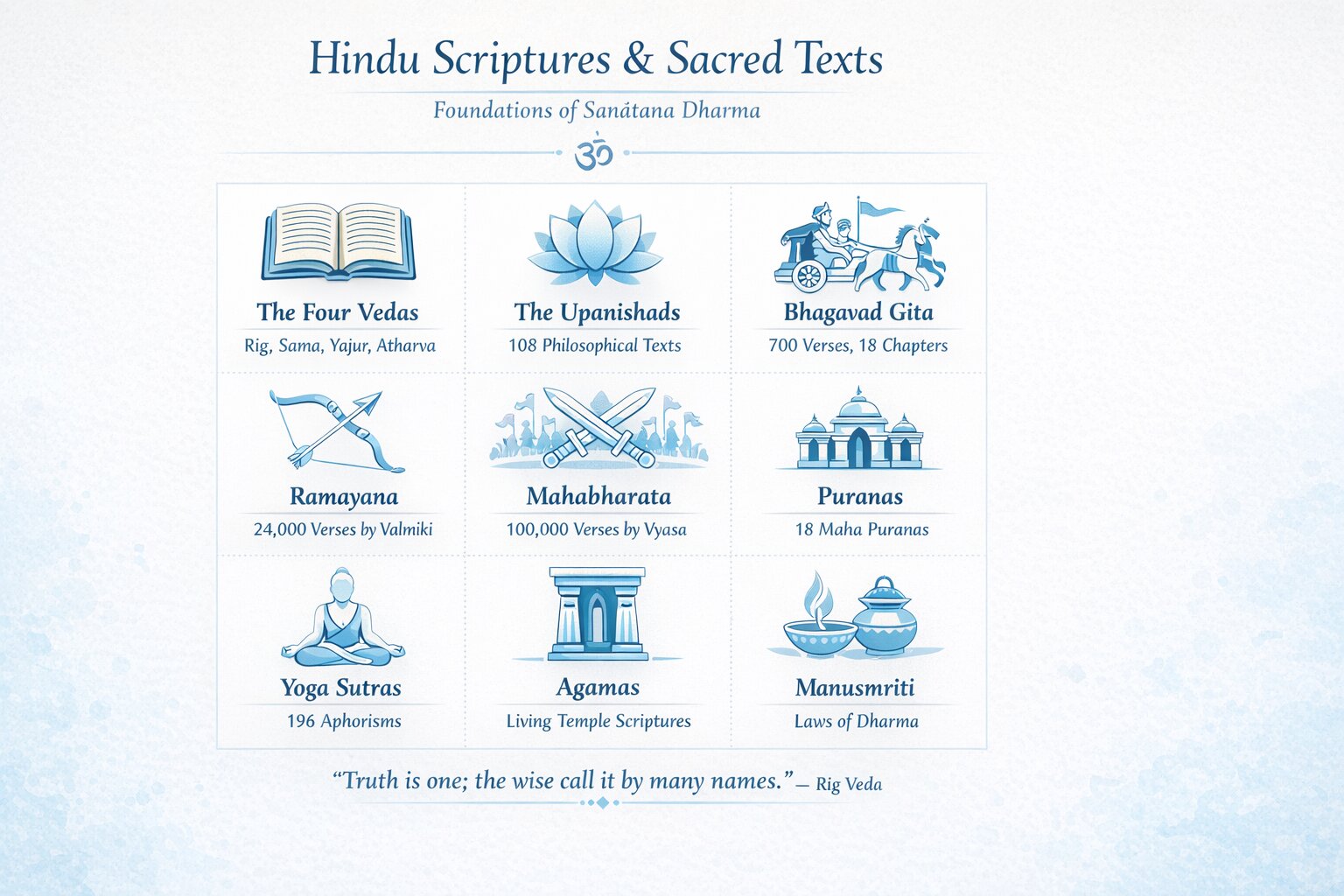
The Vedas are the primordial sacred texts of the Hindu religion and some of the oldest religious texts in the world. The word "Veda" is derived from the Sanskrit word "vid" or "to know." The oldest Veda is the Rig Veda, which is dated to 1200 BCE, although it is known to have been in use for much longer in prehistoric times.
Each Veda has four sections, known as the Samhitas, Brahmanas, Aranyakas, and Upanishads. And these four sections together are known as the "total Vedas."
- The Rig Veda is the most sacred of the four Vedas. The Rig Veda has ten Mandalas, or books, with 1,028 hymns, or verses, totalling 10,600 verses. The Nasadiya Sukta, or Hymn of Creation, from the Rig Veda "is full of questions of breathtaking philosophical audacity":
"Who really knows? Who will here proclaim it? Whence was it produced? Whence is this creation? The gods come afterwards, with the creation of this universe. Who then knows whence it has arisen?" — Rig Veda, Nasadiya Sukta (10.129)
- The Sam Veda, which Lord Krishna referred to in the Bhagavad Gita as "among the Vedas, I am the Sama Veda" (10.22), is basically the Rig Veda is song form, the oldest recorded music in the history of mankind. Sama Veda is the scripture of Indian classical music.
- The Yajur Veda is a guide for the practice of yajna or fire sacrifice. It contains both prose and verse mantras. The Yajur Veda shows the ancient Vedic perception of the importance of ritual action, performed with accuracy and full awareness, for the maintenance of cosmic order (Rta).
- The Atharva Veda is the most human of the four Vedas, with hymns dealing with healing, marriage, prosperity, and daily living. It contains ancient Ayurvedic wisdom, and its hymns on the nature of Brahman rank are some of the most philosophical in the entire range of Vedic literature.
The Vedas have been passed down through oral tradition over thousands of years before their written form and have been recognized by UNESCO as an Intangible Cultural Heritage of Humanity due to their meticulous recitation with phonological rules.
The Upanishads: Philosophy at the Summit of the Veda
Veda exists as a complete entity through the Samhitas which function as its physical form and the Upanishads serve as its spiritual essence. The 108 philosophical texts which were created between 800 BCE and 200 BCE stand as one of humanity's greatest intellectual accomplishments. The Upanishad term describes the act of "sitting near devotedly" which creates a visual representation of a student who sits at the feet of a knowledgeable instructor.
The ten main Upanishads which include Isha, Kena, Katha, Mundaka, Mandukya, Prashna, Taittiriya, Aitareya, Chandogya, and Brihadaranyaka establish Brahman — explore the nature of Brahman (ultimate reality) and Atman (which represents individual self together), and the path to moksha (which means liberation). The four Mahavakyas which function as Great Sayings contain the central teaching of this system:
- Tat Tvam Asi – "That thou art" (Chandogya Upanishad)
- Aham Brahmasmi – "I am Brahman" (Brihadaranyaka Upanishad)
- Ayam Atma Brahma – "This Self is Brahman" (Mandukya Upanishad)
- Prajnanam Brahma – "Consciousness is Brahman" (Aitareya Upanishad)
"The Self is the honey of all beings, and all beings are the honey of this Self. The bright, the immortal person who is in this Self—he is indeed the very Self, the immortal, Brahman, the All."—Brihadaranyaka Upanishad 2.5.14
The Upanishads directly inspired Vedanta philosophy which has created deep effects on global thinking that extends from German Idealism to American Transcendentalism. Henry David Thoreau wrote: "In the morning I bathe my intellect in the stupendous and cosmogonal philosophy of the Bhagvad Gita, in comparison with which our modern world and its literature seems puny and trivial."
Also read - Echoes of Wisdom: The Vedic to Modern Education Journey
The Bhagavad Gita: The Song of the Divine
No text in the whole world's literature has evoked as many translations, commentaries, and transformations as the Bhagavad Gita. Incorporated in the Mahabharata, the text exists as a dialogue which contains 700 verses to show the conversation between the warrior prince Arjuna and Lord Krishna on the day before the great Kurukshetra battle. Spanning eighteen chapters, the text presents questions about the most fundamental aspects of life: What is duty? What is self? How should one act in a world of moral complexity?
The Gita's major teaching shows people how to achieve total freedom by practicing Karma Yoga:
"You have the right to perform your prescribed duties, but you are not entitled to the fruits of your actions. Never consider yourself the cause of results, and never be attached to not doing your duty."—Bhagavad Gita 2.47
- Robert Oppenheimer, witnessing the first nuclear explosion, recalled the Gita's words from Krishna's cosmic revelation: "Now I am become Death, the destroyer of worlds." (11.32) The text exists as a unique work since it has been translated into more than 175 languages and continues to be one of the most purchased books in the world.
The Puranas: Encyclopedia of Hindu Mythology
The eighteen Maha Puranas exist as an exceptional encyclopedic text which includes complete Hindu cosmology, mythology, genealogies, yoga practices, devotional theologies, and pilgrimage traditions which contain more than 400,000 verses. The Bhagavata Purana which dedicates itself to Lord Vishnu/Krishna stands as the most cherished text because its tenth book shows Krishna's life which has inspired devotional poets from Mirabai to Jayadeva across many centuries. The Devi Bhagavata and the Devi Mahatmya within the Markandeya Purana function as the main religious text of Shaktism which shows the supreme goddess as the universe's highest power.
The Great Epics: Mahabharata & Ramayana
The Mahabharata, which Vyasa the sage wrote, runs over 1.8 million words making it the longest epic poem in existence because its length exceeds eight times the total length of both Homer's Iliad and Odyssey. The text functions as a complete encyclopedia about dharma while it tells the story of Lord Krishna and Kurukshetra battle that happened between the Kauravas and the Pandavas. The verse declares that: "Whatever is here is found elsewhere. But what is not here is nowhere else."
The Ramayana, which Valmiki the sage composed in 24,000 verses, tells the story of Prince Rama who faces exile after the demon king Ravana abducts his wife Sita but later succeeds in rescuing her with help from his devotee Hanuman. The work presents an ideal character study which shows Rama as the perfect king and son, Sita as the embodiment of grace while Hanuman represents the ultimate devotee. Nobel laureate Rabindranath Tagore wrote: "Through the Ramayana, the ideal of human virtue has been expressed more perfectly than anywhere else in Indian literature."
Agamas, Yoga Sutras & the Living Scriptures
In addition to the Vedas, Hindu tradition also has a significant collection of Agamas. The majority of these scriptures are concerned with the real-world aspects of worship. They lay out the procedural details of temple consecration, the installation of deities and the prescribed forms of daily worship such as puja. These prescribed forms of worship are still practiced in many temples all over India and in places where Hindus have migrated to elsewhere in the world
A second major text is the Yoga Sutras of Patanjali that is generally dated to around the 4th century CE. It has 196 short aphorisms that describe the discipline of yoga and its best known eightfold path.
One of its most frequently cited lines defines yoga in a simple way:
“Yogas chitta vritti nirodha”
“Yoga is the stilling of the fluctuations of the mind.”
— Yoga Sutras 1.2
The Wider Influence of Hindu Scriptures
Ideas in Hindu holy books have spread well outside of the Indian subcontinent. A classic instance is of course the address of Swami Vivekananda to the Parliament of the World's Religions in Chicago in 1893. His speech was the first time many Western ears heard of Vedantic thought, especially that every soul embodied a divine reality.
Through the ages, yoga has become increasingly popular throughout the world. Now practiced by several hundred million people, it has its spiritual origin in the ancient Indian traditions.
A verse from the Rig Veda exemplifies the broad spectrum of thought and the tolerant approach usually associated with the Hindu tradition:
“Ekam sat vipra bahudha vadanti”
“Truth is one; the wise call it by many names.”
— Rig Veda 1.164.46
Conclusion
Hindu sacred literature is the product of centuries of thought on spiritual life and the nature of reality. These writings do not present a single fixed doctrine. Rather, they are repositories of all points of view-mystical, philosophical, ritualistic, skeptical, and non-dual thinkers. Across generations, these writings ask questions about consciousness, about discipline of the self, and about the place of the sacred in human life.
As Vivekananda once said:
“The Vedas teach us that the spirit is free, unborn, undying, without beginning and without end. It is eternal, ancient, and ever-new.”